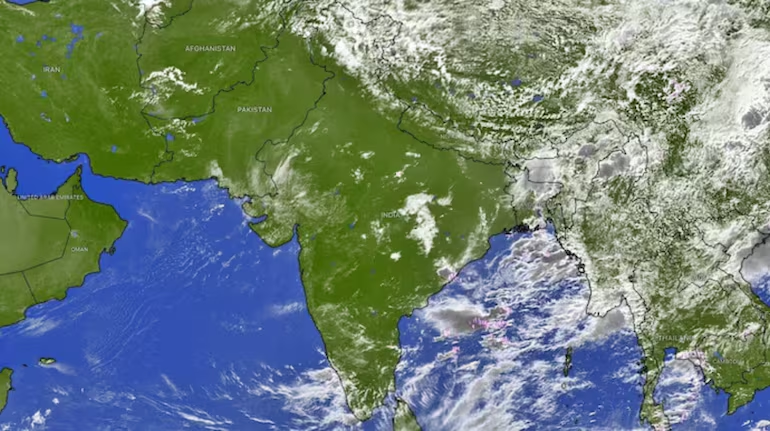
India’s 2026 monsoon is facing a serious deficit, and El Nino India Monsoon Deficit is one of the main reasons behind it. The season has already started below normal, with official forecasts and multiple reports warning that rainfall may stay weak across large parts of the country.
This is not just a weather story. A weak monsoon can affect farmers, crop output, food prices, reservoir levels, and the broader economy El Nino India Monsoon Deficit.
Table of Contents
What El Nino Means For India ?
El Niño is a warming of sea-surface temperatures in the central and eastern Pacific Ocean. When this happens, the global circulation pattern changes, and India often receives less monsoon rainfall than usual El Nino India Monsoon Deficit.
NOAA confirmed El Niño conditions in June 2026 and said the event is expected to strengthen into the Northern Hemisphere winter of 2026–27. That matters because the Indian monsoon is highly sensitive to Pacific Ocean changes El Nino India Monsoon Deficit.
Why The 2026 Monsoon Is Deficit
India Meteorological Department forecasts have already pointed to a weaker season. In late May, the IMD lowered its 2026 monsoon forecast to 90% of the long-period average, after earlier placing it at 92%.
That lower forecast was followed by a sharp early-season shortfall. By mid-June, reports showed rainfall deficits of 41% to 46% in different national snapshots. By 27 June, India was reported to have had one of its driest Junes in 146 years El Nino India Monsoon Deficit.
Why June Got Hit So Hard
El Niño alone does not explain everything. A detailed June analysis showed that five different weather systems worked against the monsoon at the same time. These included a weak Madden-Julian Oscillation, a sluggish Somali Jet, dry northwesterly air, a neutral Indian Ocean Dipole, and fewer Bay of Bengal low-pressure systems El Nino India Monsoon Deficit.
That combination slowed rain formation and delayed revival in large parts of the country. So the early deficit was caused by both the El Niño background signal and short-term atmospheric conditions.
States And Sectors At Risk El Nino India Monsoon Deficit
The biggest concern is for agriculture. Reuters reported that India’s weaker monsoon could hurt crops, reduce harvests, and increase food inflation risks. Rain-fed farming areas are especially vulnerable when the monsoon starts late or stays uneven El Nino India Monsoon Deficit.
Water supply is another major issue. If rainfall remains low, reservoir inflows, groundwater recharge, and irrigation planning can all suffer later in the season. That is why even an early deficit gets so much attention from government agencies and markets.
Can The Monsoon Still Recover
Yes, some recovery is possible. By late June, reports noted that rainfall had revived in some regions, even though the season remained weak overall. The IMD also expected some improvement as weather systems strengthened later in June.
Still, the final seasonal outcome will depend on whether El Niño remains strong and whether rain-bearing systems become more active in July and August. If those systems stay weak, the deficit could continue to pressure agriculture and inflation El Nino India Monsoon Deficit.
Economic Impact Of Weak Rainfall
A weak monsoon does not stay limited to farms. Lower crop output can push up food prices, and that can influence household budgets as well as national inflation. This is one reason the monsoon is closely watched by traders, policymakers, and consumers alike.
Reuters also reported concern that India may be heading toward its weakest monsoon in 11 years. If that happens, the effect could spread from farm incomes to consumer prices and overall growth expectations El Nino India Monsoon Deficit.
If you want to read more about El Nino India Monsoon Deficit visit All Now News Portal.
Why This Year Feels Different
The key issue in 2026 is timing. The monsoon arrived, but the rain stalled soon after, making June unusually dry. That means the problem is not just a delayed arrival; it is also a slow and uneven distribution of rainfall after onset.
This pattern is more dangerous than a simple late start because it damages sowing schedules and soil moisture at the same time. In other words, the season can still technically be active while still failing to deliver enough useful rain where it is needed El Nino India Monsoon Deficit.
What Experts Are Watching Now
Meteorologists are watching the strength of El Niño, the Somali Jet, Bay of Bengal activity, and the Indian Ocean Dipole. These factors will decide whether the monsoon deficit remains severe or improves in the second half of the season.
Also Read
7 Stunning White Sand Beach Spots in Rishikesh You Must Visit in 2026
The IMD’s forecast remains the most important official signal for the season as a whole. But short-term weather systems will decide how much damage the early deficit causes in the coming weeks.
Conclusion
El Niño is a major reason India’s 2026 monsoon deficit is so serious, but it is not the only reason. The weak season has also been shaped by a stalled atmospheric setup, which made June one of the driest in more than a century El Nino India Monsoon Deficit.
The final outcome will depend on how quickly rainfall recovers in July and August. For now, the outlook remains cautious, with clear risks for agriculture, water supplies, and food prices.
FAQs
1. What is El Niño?
El Niño is a warming of the Pacific Ocean that changes global weather patterns and often weakens the Indian monsoon.
2. Why does El Niño reduce rain in India?
It disrupts atmospheric circulation, which can suppress monsoon winds and reduce rainfall over the Indian subcontinent.
3. Is India’s 2026 monsoon below normal?
Yes. The IMD forecast the season at 90% of the long-period average, which is below normal.
4. How bad is the rainfall deficit in 2026?
Mid-June reports showed deficits around 41% to 46%, and late June analysis said India had one of its driest Junes in 146 years.
5. Is El Niño the only reason for the weak monsoon?
No. A weak Somali Jet, neutral Indian Ocean Dipole, dry air, and fewer Bay of Bengal systems also played a major role.
6. Which sectors are most affected by monsoon deficit?
Agriculture is the most affected, followed by water supply, food prices, and inflation.
7. Can the monsoon recover later in the season?
Yes, partial recovery is possible if rain-bearing systems strengthen in July and August.
8. What did NOAA say about El Niño in 2026?
NOAA said El Niño conditions were present on 10 June 2026 and expected to strengthen into winter.
9. Why is June 2026 so important?
Because June is crucial for sowing and soil moisture, and a dry start can affect the entire crop cycle.
10. Will food prices rise because of the monsoon deficit?
There is a real risk of higher food prices if rainfall stays weak and crop output falls.